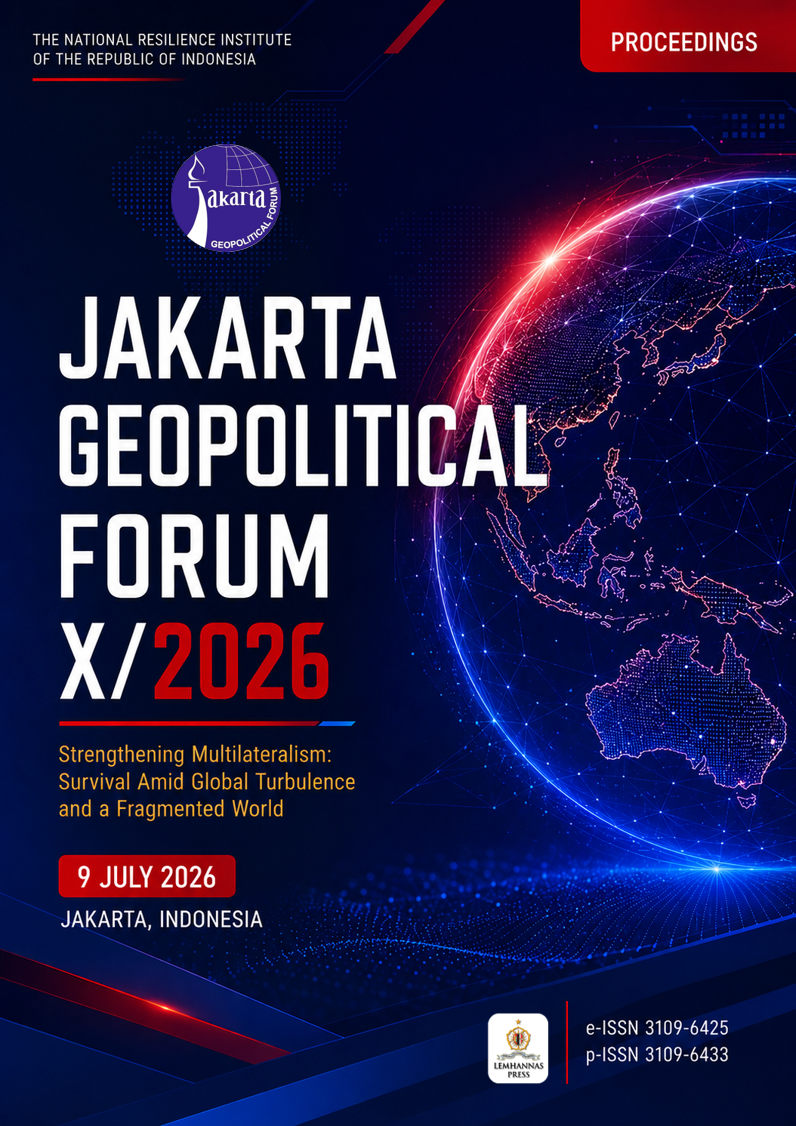
Closing Remarks at the Jakarta Geopolitical Forum X/2026: Strengthening Multilateralism: Survival Amid Global Turbulence and a Fragmented World
DOI:
https://doi.org/10.55960/jgf.v10i1.322Keywords:
International Cooperation, Multilateralism, National Resilience, Rules-Based International, Order Strategic PartnershipsAbstract
The 10th Jakarta Geopolitical Forum (JGF X) 2026 provided an important platform for strategic dialogue, knowledge exchange, and policy deliberation under the theme Strengthening Multilateralism: Survival Amid Global Turbulence and a Fragmented World. The active participation of keynote speakers, special remarks speakers, plenary speakers, moderators, policymakers, diplomats, academics, researchers, industry representatives, media partners, and participants enriched the discussions and reinforced the strategic relevance of the forum. Their collective contributions enhanced the substantive value of the forum while strengthening dialogue on multilateral cooperation in an increasingly fragmented international environment.
The forum reaffirmed that multilateralism remains a strategic necessity rather than merely an aspirational principle. For small and middle powers, including Indonesia, effective multilateral cooperation provides an essential foundation for safeguarding sovereignty, maintaining predictability, promoting equitable partnerships, and preserving international peace amid shifting geopolitical dynamics. The first plenary session highlighted that the weakening of multilateralism reflects not only institutional shortcomings but also shifting power relations, strategic ambiguity, and the erosion of respect for international norms. Accordingly, middle powers should continue strengthening rules-based cooperation through regional partnerships, legal innovation, and consistent diplomacy.
The three plenary sessions collectively highlighted the multidimensional nature of contemporary geopolitical challenges. The second plenary session demonstrated that economic policy has become inseparable from national security, with tariffs, sanctions, critical minerals, green industrial policy, currency competition, and supply-chain reconfiguration increasingly functioning as strategic instruments that require adaptive, resilient, and pragmatic policy responses. The third plenary session further emphasised that technological competition, cybersecurity, artificial intelligence, digital infrastructure, and the future of work will significantly shape national resilience. The discussions also reaffirmed that the demographic dividend can only become a strategic advantage when supported by sustained investment in human capital development, digital skills, data governance, ethical artificial intelligence, and secure critical infrastructure.
The forum further agreed that its deliberations should extend beyond academic exchange and generate practical policy contributions. The proceedings, the Forum Pulse, and the substantive recommendations developed through the forum will provide strategic inputs for national decision-makers while supporting Indonesia's national resilience and its constructive contribution to regional and global governance. These outputs are expected to serve as practical references for government institutions, academia, industry, think tanks, and international partners in responding to the evolving geopolitical, geoeconomic, and geotechnological landscape.
The discussions also produced a shared understanding that middle powers should remain active contributors rather than passive observers within an increasingly fragmented international system. Indonesia's independent and active foreign policy continues to provide an appropriate framework for strengthening strategic partnerships, maintaining balanced international relations, safeguarding national interests, and contributing to a peaceful, inclusive, and rules-based international order. Within this context, strengthening resilience requires simultaneous progress at the national, regional, and global levels through strong institutions, high-quality human resources, economic competitiveness, energy security, digital readiness, ASEAN cohesion, practical regional cooperation, revitalised multilateralism, and continued respect for international law.
Finally, the forum reaffirmed that trade diversification, green economic transformation, resilient supply chains, digital sovereignty, and cybersecurity should ultimately contribute to safeguarding Indonesia's sovereignty, advancing national prosperity, and supporting a more stable, peaceful, and sustainable international order. The forum concluded with the shared aspiration that the partnerships, dialogue, and ideas developed throughout the discussions will continue to evolve into concrete cooperation for Indonesia, the region, and the wider international community.
Downloads
References
References
1. Lembaga Ketahanan Nasional Republik Indonesia (Lemhannas RI). Jakarta Geopolitical Forum X/2026: Strengthening Multilateralism: Survival Amid Global Turbulence and a Fragmented World [video on the Internet]. Jakarta: Lemhannas RI; 2026 Jul 9 [cited 2026 Jul 17]. Available from: https://www.youtube.com/watch?v=IbYayky-FmQ
Downloads
Published
Conference Proceedings Volume
Section
License
Copyright (c) 2026 T.B. Ace Hasan Syadzily (Author)

This work is licensed under a Creative Commons Attribution-ShareAlike 4.0 International License.