Beyond Great Powers: Middle Powers and the Future of Multilateral Cooperation
DOI:
https://doi.org/10.55960/jgf.v10i1.310Abstract
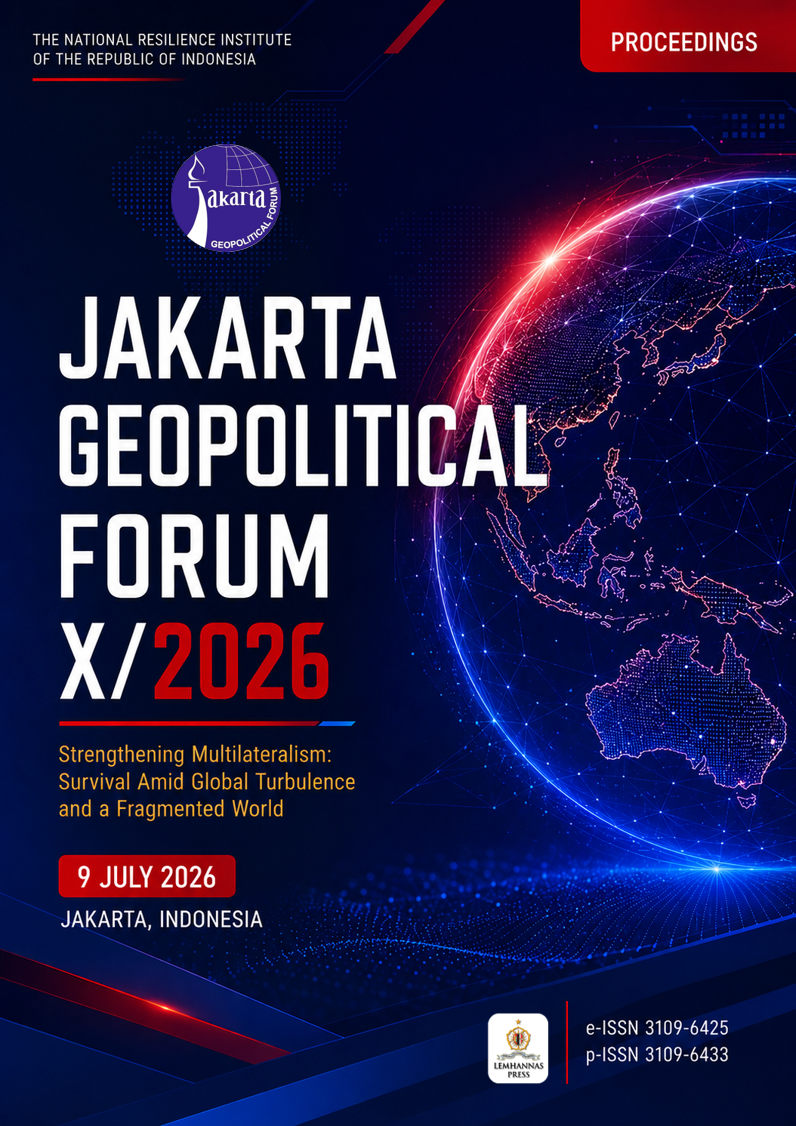
This conference paper presents an academic adaptation of Professor Nick Bisley's presentation at the Jakarta Geopolitical Forum X, examining the evolving role of middle powers in sustaining multilateral cooperation amid increasing geopolitical uncertainty. The presentation explains that the post-Cold War environment, characterised by strategic stability, revitalised multilateralism, and economic openness, has shifted towards intensified great-power competition, institutional fragmentation, and a more politicised global economy. In response, middle powers increasingly rely on both multilateral and minilateral cooperation, although arrangements including the Quad and AUKUS have yet to demonstrate consistent effectiveness. The presentation further argues that effective cooperation depends on clearly defined shared interests, sustained leadership, and tangible outcomes rather than the expansion of institutional mechanisms. The Comprehensive and Progressive Agreement for Trans-Pacific Partnership (CPTPP) demonstrates the capacity of middle powers to achieve meaningful cooperation through pragmatic leadership and long-term commitment. The presentation concludes by identifying maritime security, domestic security infrastructure, and economic resilience as practical priorities through which middle powers can strengthen international cooperation and contribute to regional and global stability despite their structural limitations.
Downloads
Downloads
Published
Conference Proceedings Volume
Section
License
Copyright (c) 2026 Nick Bisley (Author)

This work is licensed under a Creative Commons Attribution-ShareAlike 4.0 International License.