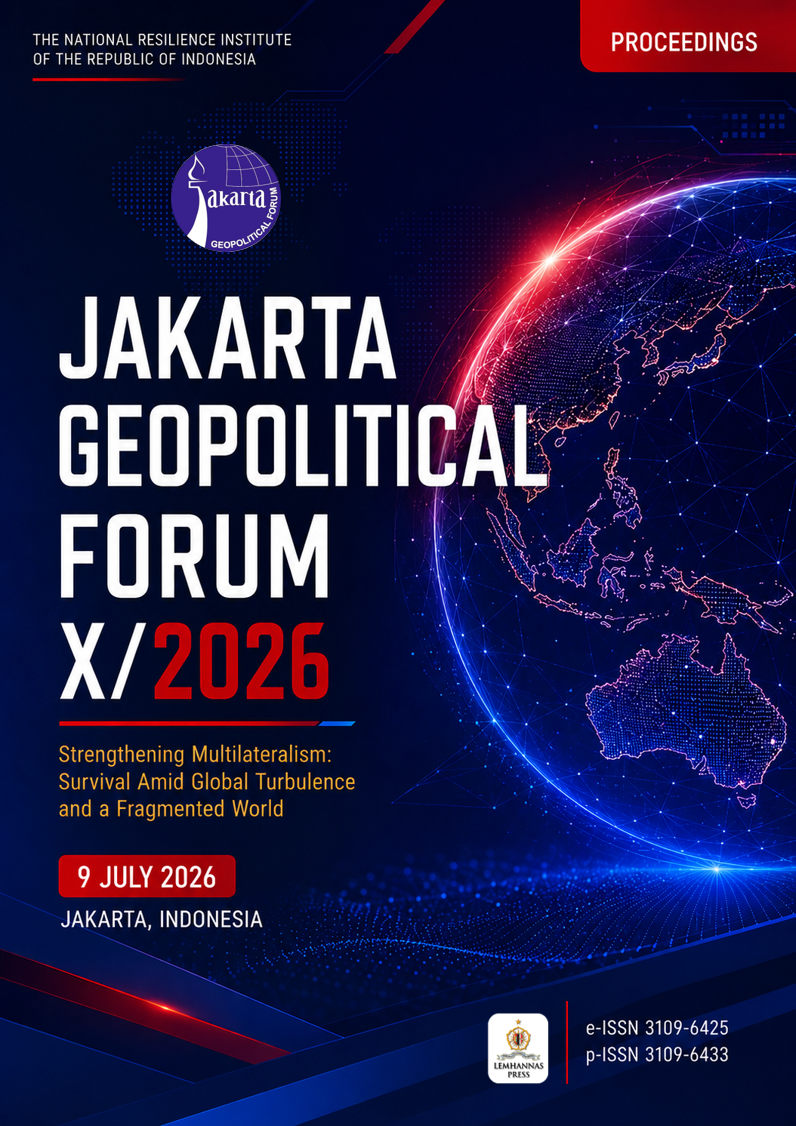
Conference Summary at the Jakarta Geopolitical Forum X/2026: Strengthening Multilateralism: Survival Amid Global Turbulence and a Fragmented World
DOI:
https://doi.org/10.55960/jgf.v10i1.321Keywords:
Bebas Aktif, Multilateralism, National Resilience, Rules-Based International, Order Strategic CapabilityAbstract
Bismillahirrahmanirrahim.
Assalamu'alaikum warahmatullahi wabarakatuh.
May peace and blessings be upon us.
Om Swastiastu, Namo Buddhaya, Salam Kebajikan.
The Honourable Governor of the National Resilience Institute of the Republic of Indonesia, Dr. H. TB Ace Hasan Syadzily;
The Honourable Vice Governor of the National Resilience Institute of the Republic of Indonesia;
Excellencies; distinguished moderators, speakers, and participants, both here in the conference hall and joining us online; ladies and gentlemen.
We have now reached the conclusion of the forum, and it is my honour to present a summary of the substantive discussions of the 10th Jakarta Geopolitical Forum 2026.
Under the theme, "Strengthening Multilateralism: Survival Amid Global Turbulence and a Fragmented World," a common question emerged throughout every session: Who will write the next set of global rules, and who will build the capability to live by them? Writing the rules is one challenge; possessing the infrastructure, economic strength, institutional resilience, and technological capability to survive and prosper under those rules is another.
This morning, the Minister of Foreign Affairs of the Republic of Indonesia, His Excellency Sugiono, opened our discussions by asking whether multilateralism can still deliver. His answer was clear: yes-but not on autopilot. The remedy for imperfect multilateralism is not less multilateralism, but better multilateralism. He reaffirmed Indonesia's Bebas Aktif foreign policy as an approach that expands strategic space rather than forcing countries to choose between competing blocs. That strategic space must ultimately be anchored in national capability, because sovereignty is meaningful only when supported by resilience and capacity.
Our first plenary session examined the future of multilateralism in an increasingly multipolar world. Professor Nick Bisley reminded us that middle powers cannot reshape the international order through grand strategic designs. Instead, they must pursue pragmatic, issue-based coalitions built upon shared interests, practical leadership, and tangible outcomes, as demonstrated by countries that sustained the Comprehensive and Progressive The Comprehensive and Progressive Agreement for Trans-Pacific Partnership (CPTPP), sustained following the withdrawal of the United States, demonstrates the continuing relevance of this form of cooperation in areas including maritime security, domestic resilience, and economic diversification.
Professor Georgy Toloraya presented a perspective in which emerging platforms such as BRICS and the Shanghai Cooperation Organisation complement rather than replace the United Nations. In his view, multipolarity should not be interpreted as disorder, but as a search for a new international equilibrium. He also proposed stronger engagement between ASEAN and Eurasian institutions through economic cooperation, energy collaboration, civilian nuclear development, and cooperation on ethical frameworks for artificial intelligence.
Professor Hikmahanto Juwana reminded us that international law continues to face significant limitations whenever major powers choose to disregard established legal decisions. Nevertheless, he emphasised that Indonesia should remain committed to preventing escalation, maintaining dialogue wherever cooperation remains possible, and consistently implementing its Bebas Aktif foreign policy with many friends and no enemies. Although each speaker approached the issue from different perspectives, the session ultimately converged on a shared conclusion: the international order is under considerable pressure, and middle powers must respond through pragmatic cooperation, sustained diplomacy, and strengthened multilateral engagement rather than confrontation.
Downloads
References
References
1. Lembaga Ketahanan Nasional Republik Indonesia (Lemhannas RI). Jakarta Geopolitical Forum X/2026: Strengthening Multilateralism: Survival Amid Global Turbulence and a Fragmented World [video on the Internet]. Jakarta: Lemhannas RI; 2026 Jul 9 [cited 2026 Jul 17]. Available from: https://www.youtube.com/watch?v=IbYayky-FmQ
Downloads
Published
Conference Proceedings Volume
Section
License
Copyright (c) 2026 Ipung Purwadi (Author)

This work is licensed under a Creative Commons Attribution-ShareAlike 4.0 International License.