Special Remarks Cyber Power and Global Competition: How Small and Middle Powers Can Leverage Digital Economic Transformation
DOI:
https://doi.org/10.55960/jgf.v10i1.317Keywords:
Artificial Intelligence, Critical Minerals, Digital Statecraft, National Resilience, Technological CompetitivenesAbstract
Artificial intelligence (AI) is reshaping global economic and geopolitical competition as a general-purpose technology whose strategic value depends not only on innovation but also on its widespread application across the real economy. Lasting technological leadership requires human capital, engineering capability, digital infrastructure, and institutional readiness that enable AI adoption across manufacturing, healthcare, education, logistics, and public services. Historical experience demonstrates that competitive advantage depends on diffusing technological innovation throughout productive sectors rather than introducing breakthroughs alone.
Strategic rivalry between the United States and China has intensified competition in semiconductors, computing technologies, export controls, and critical mineral supply chains, extending beyond frontier innovation to broader industrial ecosystems and computing capacity. These developments also create opportunities for small and middle powers to strengthen their strategic relevance by leveraging national comparative advantages.
Indonesia possesses important strategic assets to support its role in the digital economy. The presentation introduced digital statecraft as the strategic management of digital ecosystems to advance national objectives through economic and technological instruments. Four complementary sources of national leverage were identified: resource power, market power, demographic power, and compute power. Indonesia's reserves of nickel, cobalt, copper, bauxite, and silica, combined with its large digital economy and young population, provide significant advantages that should be supported by stronger computing capability, advanced digital talent, and industrial capacity to generate greater value beyond resource extraction.
Critical minerals were presented as Indonesia's principal strategic advantage in the emerging AI economy. Their importance extends beyond commodity production to supporting batteries, semiconductors, data centres, and AI infrastructure, while creating opportunities to secure technology transfer, advanced manufacturing partnerships, and deeper participation in global technology value chains.
The presentation further identified data sovereignty as the foundation connecting all dimensions of digital statecraft. As AI increasingly depends on data generated across economic and public activities, governance should strengthen domestic capability, support technology transfer, and ensure that AI systems reflect Indonesia's language, legal framework, and national priorities while maintaining international cooperation.
Indonesia's digital transformation should advance through two complementary strategies: leveraging critical minerals to expand access to computing technologies, semiconductor capability, manufacturing partnerships, and advanced processing, while strengthening sovereign computing capacity through investment in data centres, secure cloud infrastructure, research institutions, semiconductor capability, and highly skilled digital talent. These priorities are reinforced through chip diplomacy, reliable energy infrastructure, AI and semiconductor talent development, stronger data sovereignty, and AI systems designed to address Indonesia's national context.
The presentation concluded that long-term technological competitiveness depends on sustained political commitment, institutional continuity, and investment in strategic capability. By integrating critical minerals, digital markets, demographic advantages, computing capacity, and institutional strength, Indonesia can reinforce its position as an indispensable technological partner while enhancing national resilience and competitiveness in an increasingly contested digital environment.
Downloads
References
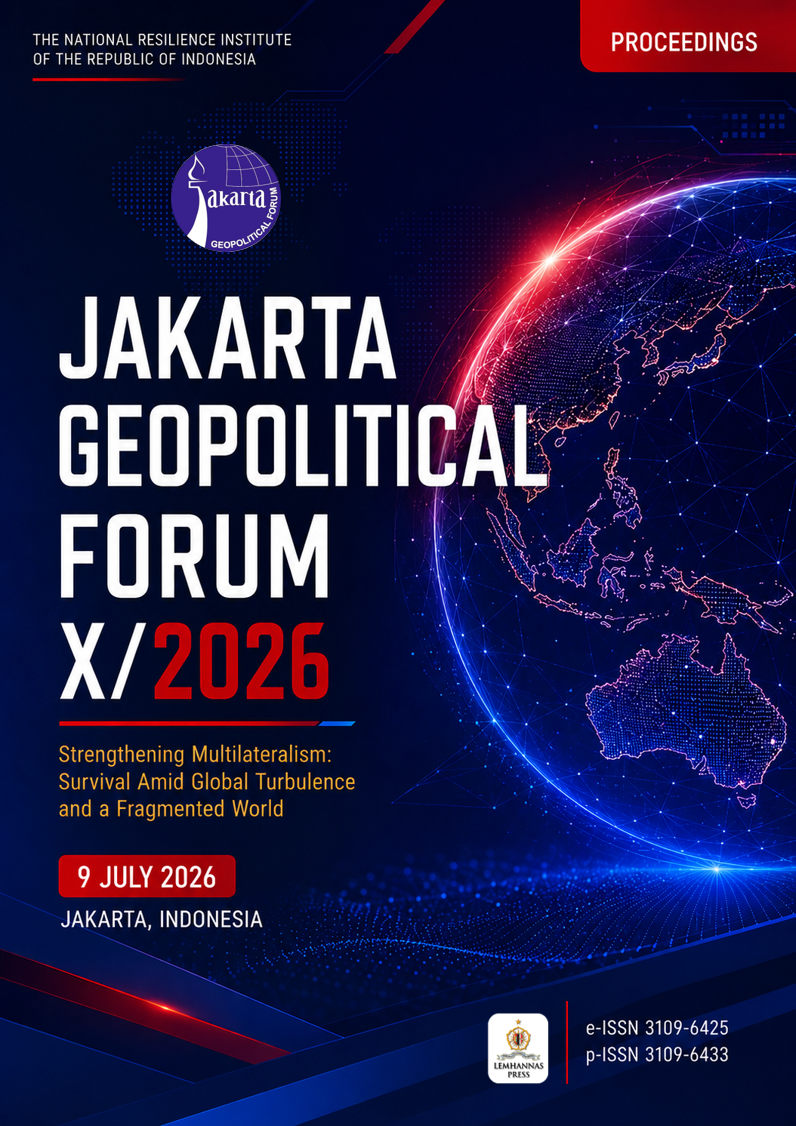
1. Lembaga Ketahanan Nasional Republik Indonesia (Lemhannas RI). Jakarta Geopolitical Forum X/2026: Strengthening Multilateralism: Survival Amid Global Turbulence and a Fragmented World [video on the Internet]. Jakarta: Lemhannas RI; 2026 Jul 9 [cited 2026 Jul 17]. Available from: https://www.youtube.com/watch?v=IbYayky-FmQ
Downloads
Published
Conference Proceedings Volume
Section
License
Copyright (c) 2026 Nezar Patria (Author)

This work is licensed under a Creative Commons Attribution-ShareAlike 4.0 International License.