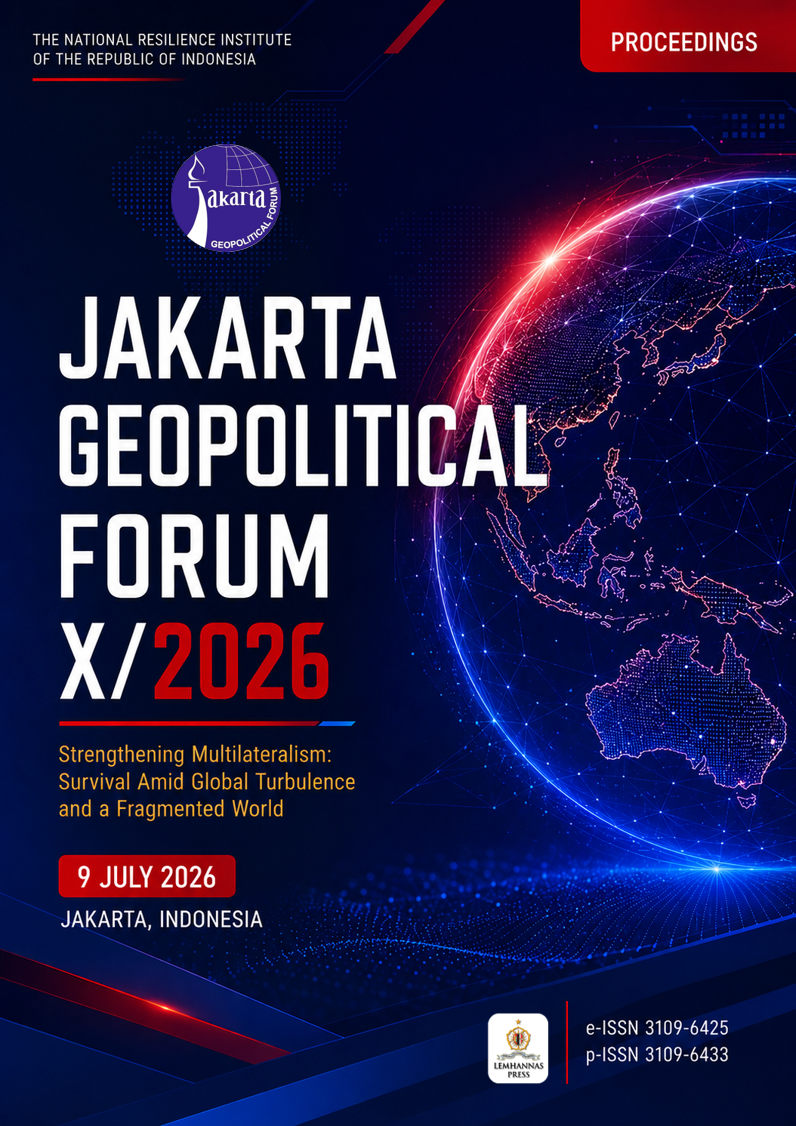
Advancing a Sustainable Green Economy: Cooperation, Strategic Resources, and the Future of Industrial Transformation
DOI:
https://doi.org/10.55960/jgf.v10i1.315Keywords:
Critical Minerals, Green Economy, Industrial Decarbonisation, Nickel Downstreaming, Regulatory CooperationAbstract
This paper discusses Indonesia’s strategic position in the global transition towards a sustainable green economy, particularly through its substantial critical mineral resources and nickel downstreaming policy. Indonesia holds a significant share of global nickel reserves and possesses other critical minerals required for clean technology development. The presentation argues that responsible downstreaming can increase domestic value creation, support economic transformation, and contribute to Indonesia’s long-term development targets. Nevertheless, green industrial policies may produce exclusionary effects when international standards, trade measures, and regulatory requirements restrict market access or disregard the domestic frameworks of producer countries. Cooperative green industrial measures should therefore expand clean technology capacity, accelerate industrial decarbonisation, distribute value fairly across supply chains, and recognise equivalent domestic regulations. The presentation proposes three principles for sustainable industrial standards: mutual recognition between domestic and international frameworks, support for technology transfer, investment, capacity development, and skills, and appropriate market recognition for responsibly produced goods. It concludes that producers, consumers, standard-setting bodies, and other relevant stakeholders should jointly formulate interoperable rules rather than allow any single bloc to determine global standards unilaterally.
Downloads
Downloads
Published
Conference Proceedings Volume
Section
License
Copyright (c) 2026 Arief Wijaya (Author)

This work is licensed under a Creative Commons Attribution-ShareAlike 4.0 International License.